【Key Highlights】
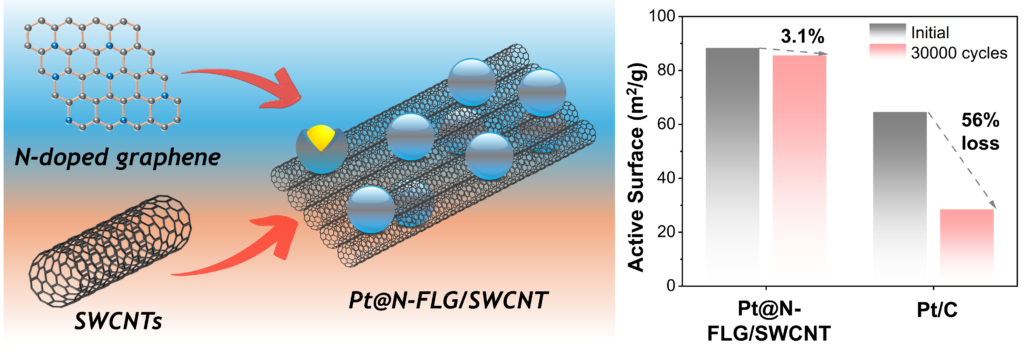
- Developed a novel fuel cell catalyst consisting of platinum nanoparticles encapsulated by nitrogen-doped few-layer graphene1) and supported on single-walled carbon nanotubes (SWCNTs)2).
- Achieved oxygen reduction reaction (ORR)3) activity superior to that of commercial catalysts through the strong interaction between graphene and platinum.
- Demonstrated outstanding durability in membrane electrode assembly (MEA)4) tests under practical fuel cell operating conditions, retaining 96.9% of the catalyst surface area even after 30,000 cycles.
- Contributes to the development of high-performance, long-life fuel cells, supporting broader adoption in automobiles and heavy-duty transportation applications.
A research team led by Miftakhul Huda (Designated Lecturer), Chuyang Yu (Ph.D. student), and Yutaka Matsuo (Professor) from the Graduate School of Engineering and the Institute of Materials Innovation (IMaSS) at Nagoya University, in collaboration with Meijo Nano Carbon Co., Ltd., has developed a novel fuel-cell electrocatalyst, Pt@N-FLG/SWCNT, in which platinum nanoparticles are encapsulated within nitrogen-doped few-layer graphene and immobilized on single-walled carbon nanotubes (SWCNTs).
Polymer electrolyte fuel cells (PEFCs)5) are considered a key energy-conversion technology for the realization of a hydrogen-based society because they generate electricity from hydrogen and oxygen without emitting carbon dioxide during operation. However, the widespread deployment of PEFCs requires both enhanced activity and durability of expensive platinum catalysts, as well as improved corrosion resistance of the carbon supports used to anchor them.
To address these challenges, the researchers encapsulated platinum nanoparticles with nitrogen-doped few-layer graphene (N-FLG), protecting the platinum from degradation while replacing conventional carbon black supports with chemically durable SWCNTs. The study further revealed that the strong interaction between nitrogen-doped graphene and platinum modifies the electronic structure of platinum, creating a more favorable state for the oxygen reduction reaction (ORR).
As a result, the newly developed catalyst exhibited higher ORR activity than commercial Pt/C catalysts. In membrane electrode assembly (MEA) tests that simulate practical fuel-cell operation, the catalyst retained 96.9% of its electrochemically active surface area after 30,000 accelerated durability cycles6). Furthermore, even after 5,000 cycles under harsh high-potential conditions (1.0-1.5 V), the loss of electrochemically active surface area7) was limited to only 27.2%, and no voltage degradation was observed at a high current density of 1.5 A cm⁻².
These results exceed the durability targets established by the U.S. Department of Energy (DOE) for both electrocatalysts and carbon supports and represent a significant step toward the realization of next-generation fuel cells with both high performance and long operational lifetimes.
The research was published online in ACS Catalysis on August 24, 2026.
◆For more details, please refer to the full press release:
https://www.nagoya-u.ac.jp/researchinfo/result/upload_images/20260930_engg.pdf
Glossary
1) Nitrogen-Doped Few-Layer Graphene (N-FLG)
A material consisting of several graphene layers, in which some carbon atoms are replaced by nitrogen atoms. Nitrogen doping enables control of the electronic structure and chemical reactivity of graphene, enhancing its functionality in catalytic applications.
2) Single-Walled Carbon Nanotube (SWCNT)
A nanomaterial formed by rolling a single graphene sheet into a cylindrical structure with a diameter of only a few nanometers. SWCNTs exhibit excellent electrical conductivity, mechanical strength, and chemical stability.
3) Oxygen Reduction Reaction (ORR)
The electrochemical reaction occurring at the cathode (air electrode) of a fuel cell, where oxygen is reduced to form water. Because ORR is kinetically slow, highly active catalysts such as platinum are generally required to achieve high fuel-cell performance.
4) Membrane Electrode Assembly (MEA)
The core component of a fuel cell, consisting of catalyst layers deposited on both sides of a polymer electrolyte membrane. It is the active region where the electrochemical reactions for power generation take place.
5) Polymer Electrolyte Fuel Cell (PEFC)
A fuel cell that generates electricity through the electrochemical reaction of hydrogen and oxygen. PEFCs operate at relatively low temperatures and offer high power density, making them attractive for automotive and various other applications.
6) Accelerated Durability Test (ADT/AST)
A testing method used to evaluate catalyst and support degradation within a shortened timeframe by applying repeated potential cycles or other accelerated stress conditions that simulate long-term fuel-cell operation.
7) Electrochemically Active Surface Area (ECSA)
The portion of the catalyst surface, typically platinum, that is accessible for electrochemical reactions. ECSA is one of the most important metrics for evaluating catalyst activity and durability in fuel cells.
Publication Information
Title:
Pt–N Interactions and Nitrogen-Doped Graphene-Shell Encapsulation in Platinum Electrocatalysts Supported by SWCNTs for Enhanced ORR Activity and Durability
Authors:
Chu-Yang Yu, Qiao Chen, Xue-Lin Zheng, Kiho Yamada, Takeshi Hashimoto, Nagahiro Saito, Masaya Kawasumi*, Miftakhul Huda*, and Yutaka Matsuo*
(*Corresponding Authors)
Journal: ACS Catalysis
Published Online: August 24, 2026
DOI: https://doi.org/10.1021/acscatal.6c04836
DOI:10.1021/acscatal.6c03908
URL:https://doi.org/10.1021/acscatal.6c03908